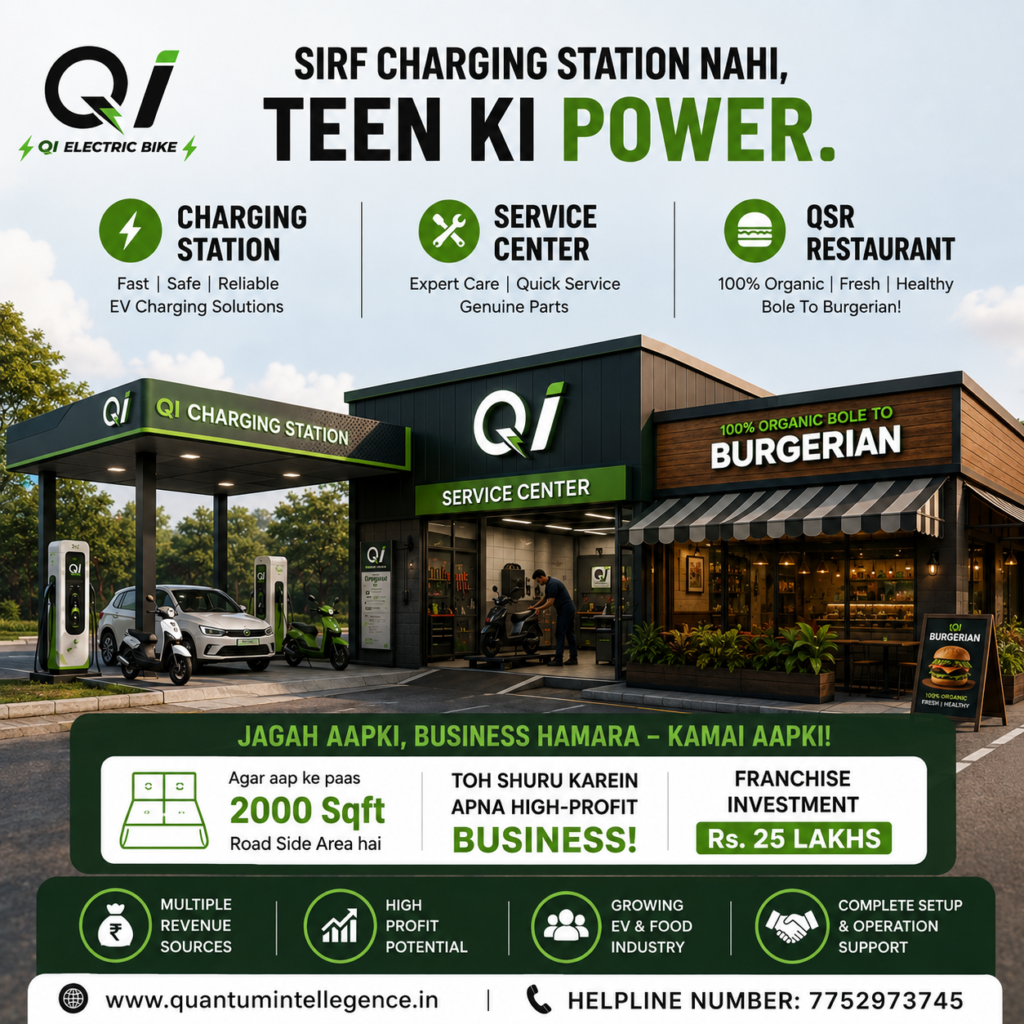
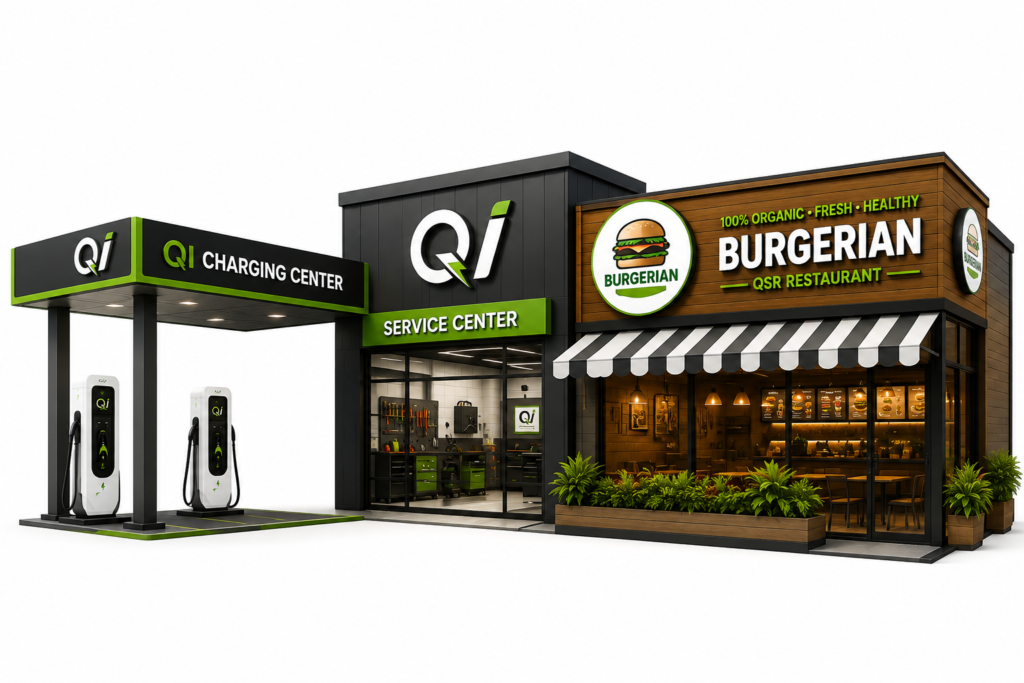
Charging Station with Service Center

QI HIGHWAY PREMIUM EV & BATTERY TESTING HUB
Complete Investment & Financial Model — ₹35 Lakhs

Not Just a Charging Station

Fast Charging | EV Service | Battery Exchange | Battery Health Testing

Proposed Location: Highway / Expressway / High-Traffic Road
Recommended Land: Approximately 5,000 Sq. Ft.
Total Core Investment: ₹35 Lakhs
Land Cost/Rent: Not included


1. BUSINESS CONCEPT

The QI Highway Premium EV & Battery Hub is designed as a multi-revenue EV destination rather than a charging-only facility.

The centre combines:

  • 🚗 Electric Car Fast Charging
  • 🛵 Electric Bike/Scooter Charging
  • 🛺 Electric Auto/E-Rickshaw Charging
  • 🛠️ EV Service & Repair Centre
  • 🔄 Battery Exchange
  • 🔬 Battery Health Testing & Diagnostics
  • 📱 Digital Customer/Charging Management
  • 🪧 Highway Branding & Visibility

The objective is to generate revenue from multiple EV-related services at the same location.


2. TOTAL INVESTMENT — ₹35 LAKHS

ComponentEstimated Investment
2 × 60 kW DC Fast Chargers₹16.00 L
2 AC Car Charging Points₹1.00 L
8 Two-Wheeler Charging Points₹0.80 L
6 Three-Wheeler Charging Points₹0.80 L
Electrical Infrastructure₹4.00 L
Charging Canopy + Civil + Parking₹2.00 L
EV Service Centre Equipment₹3.00 L
Battery Exchange Station₹1.50 L
Battery Health Testing Equipment₹2.00 L
CCTV / POS / Software / Networking₹0.75 L
Fire & Safety Equipment₹0.50 L
Highway Branding & Signage₹0.65 L
Contingency / Pre-Opening Expenses₹1.00 L
TOTAL INVESTMENT₹35.00 LAKHS

Note: These are indicative project-planning figures. Actual costs will depend on charger manufacturer, electrical load, DISCOM requirements, civil work, site conditions, taxes and supplier quotations.


3. CHARGING INFRASTRUCTURE

🚗 Electric Cars
4 Car Charging Bays

2 × 60 kW DC Fast Chargers

Plus:

2 × AC Car Charging Points

This provides a combination of high-speed and destination charging.


🛵 Electric Bikes & Scooters

8 Charging Points

Designed for QI electric two-wheelers and compatible EVs.


🛺 Electric Autos / E-Rickshaws

6 Charging Points

Designed for QI three-wheelers and compatible vehicles.


TOTAL INITIAL CHARGING CAPACITY

🚗 Cars: 4 Bays

🛵 Bikes/Scooters: 8 Points

🛺 Autos/E-Rickshaws: 6 Points

18 Charging Bays/Points

The final number of simultaneously active charging points and their power ratings must be confirmed against the sanctioned electrical load and the specifications of the vehicles/chargers.


4. WHY TWO 60 kW DC CHARGERS?

Instead of relying on a single high-power charger, the QI Highway model uses:

2 × 60 kW DC Fast Chargers

This provides:

  • Better charger availability
  • Reduced risk of total downtime
  • Ability to serve multiple highway customers
  • Better peak-period capacity
  • Scope for future expansion

A charger with multiple connectors may share available power between vehicles, so the final technical configuration should specify charger power, connector count and simultaneous output separately.


5. 🛠️ EV SERVICE CENTRE

The service centre creates a second major revenue stream.

Services can include:

  • EV periodic servicing
  • Motor diagnostics
  • Controller diagnostics
  • Battery diagnostics
  • Brake service
  • Suspension
  • Tyre and puncture service
  • Electrical repairs
  • Wiring and electrical troubleshooting
  • Spare parts replacement
  • Emergency highway assistance
  • Software/diagnostic support
  • 2W and 3W EV servicing

Revenue Sources

Labour Charges + Spare Parts Margin + Diagnostics + Paid Repairs + Service Packages


6. 🔄 BATTERY EXCHANGE CENTRE

Battery exchange is designed as a major additional revenue stream.

QI model:

Customer arrives

Battery Health Check

Battery Exchange Valuation

Replacement Battery Order

Warehouse Dispatch

Customer Receives Replacement Battery

The centre does not need to maintain a large inventory of replacement batteries under the proposed warehouse-fulfilment model.

This can reduce working-capital requirements and inventory risk.


7. 🔬 BATTERY HEALTH TESTING CENTRE

Every used battery can be assessed before exchange, resale or further processing.

Proposed diagnostic process:

Battery Identification

Voltage Test

BMS Diagnostics

Cell Voltage Balance

Capacity / SOH Assessment

Physical & Safety Inspection

Digital Battery Health Report


8. BATTERY GRADING SYSTEM

🟢 Grade A

High State of Health

Potentially suitable for continued EV use, subject to technical assessment.

🟡 Grade B

Moderate State of Health

Potentially suitable for appropriate second-life applications, subject to assessment.

🟠 Grade C

Lower State of Health

Limited reuse potential; technical evaluation required.

🔴 Unsafe / Damaged

Not for resale or reuse.

Should be handled through the appropriate authorised battery waste/recycling channel.

These grades are proposed QI business classifications and should not be represented as statutory standards.


9. BATTERY EXCHANGE REVENUE MODEL

Example only:

Customer Exchange Price: ₹12,000
Warehouse/Landed Cost: ₹10,000

Gross Margin:

₹2,000 per battery

If the centre handles:

6 exchanges/day

6 × ₹2,000 × 26 days

₹3.12 Lakhs/month Gross Margin

Annual:

₹37.44 Lakhs/year Gross Margin

This is an illustrative assumption, not a guaranteed margin. Actual profitability depends on QI’s warehouse price, customer price, logistics, taxes and franchise agreement.


10. BATTERY HEALTH TESTING REVENUE

Illustrative assumption:

12 tests/day

Average testing fee:

₹300

12 × ₹300 × 26 days

₹93,600/month

Annual:

₹11.23 Lakhs

Actual testing fees and test duration will depend on the battery type and diagnostic equipment.


11. 🔋 CHARGING REVENUE PROJECTION

Illustrative base-case assumption:

Electric Cars

25 charging sessions/day
Average billing: ₹450

25 × ₹450 × 26

= ₹2.93 Lakhs/month

Electric Bikes/Scooters

35 sessions/day
Average billing: ₹80

35 × ₹80 × 26

= ₹72,800/month

Electric Autos

25 sessions/day
Average billing: ₹130

25 × ₹130 × 26

= ₹84,500/month

Total Estimated Charging Revenue

≈ ₹4.51 Lakhs/month

Annual:

≈ ₹54.1 Lakhs/year

This is gross charging revenue, before electricity and other operating costs.


12. 🛠️ SERVICE CENTRE REVENUE

Illustrative assumption:

10 vehicles/day

Average service invoice:

₹1,000

10 × ₹1,000 × 26

₹2.60 Lakhs/month

Annual:

₹31.20 Lakhs/year

The actual service contribution depends on parts cost, technician wages, warranty work and labour margins.


13. MONTHLY BUSINESS POTENTIAL

Revenue / Contribution StreamMonthly
🔋 Charging Revenue₹4.51 L
🛠️ Service Revenue₹2.60 L
🔄 Battery Exchange Gross Margin₹3.12 L
🔬 Battery Testing Revenue₹0.94 L
Indicative Combined Business Inflow/Contribution₹11.17 L

Important:

This ₹11.17 lakh is not net profit.

Charging and service figures are gross revenue, while the battery exchange figure is an assumed gross margin. A proper P&L must separately account for electricity, spare parts, labour, logistics, taxes and operating expenses.


14. ESTIMATED CONTRIBUTION

Illustrative planning assumptions:

BusinessEstimated Monthly Contribution
🔋 Charging₹1.70–2.00 L
🛠️ Service₹1.10–1.30 L
🔄 Battery Exchange₹3.12 L
🔬 Battery Testing~₹0.70 L
Total Contribution₹6.62–7.12 L

15. MONTHLY OPERATING EXPENSES

Indicative expenses:

  • Staff salaries
  • Centre manager
  • Electricity
  • Maintenance
  • Software/platform charges
  • Security
  • Cleaning
  • Internet
  • Marketing
  • Insurance
  • Administrative expenses
  • Consumables
  • Equipment maintenance

Estimated range:

₹1.50–2.00 Lakhs/month

Actual rent/lease is excluded and must be added if applicable.


16. PROJECTED OPERATING PROFIT

Conservative Scenario

₹1.5–2.0 Lakhs/month

Base / Target Scenario

₹2.5–3.5 Lakhs/month

High-Traffic Scenario

₹4.5–5.5+ Lakhs/month

The high-traffic scenario requires strong highway traffic, good charger utilization and substantial battery-exchange volumes.


17. ANNUAL PROFIT POTENTIAL

Conservative

₹1.5 L × 12

₹18 Lakhs/year

Base

₹3.0 L × 12

₹36 Lakhs/year

High

₹5.0 L × 12

₹60 Lakhs/year

These are operating-profit planning scenarios, before financing costs, income tax, depreciation and other accounting adjustments.


18. INVESTMENT PAYBACK

Total Core Investment:

₹35 Lakhs

If the centre achieves an average operating profit of:

₹3 Lakhs/month

Mathematical payback:

₹35L ÷ ₹3L ≈ 12 months

However, a new highway centre will normally require a ramp-up period.

Therefore, for investor/franchise marketing, I recommend:

Indicative Practical Payback: 18–24 Months

Conservative case:

24–36+ months

Actual payback will depend heavily on utilization and battery-exchange margins.


19. PHASE-2 GREEN ENERGY UPGRADE

After the core highway business is operational:

☀️ 5 kW Solar

Approx. ₹3 Lakhs

🌬️ 3 kW Wind Turbine

Approx. ₹3 Lakhs

Additional Investment:

₹6 Lakhs

Total:

₹41 Lakhs

The solar and wind systems should primarily be presented as renewable-energy generation and electricity-cost reduction, not guaranteed revenue.


20. OPTIONAL QSR RESTAURANT

A QSR can be added as a separate business module.

Additional Investment:

₹7 Lakhs

Then:

₹35 Lakh Core Highway EV Hub

  • ₹6 Lakh Solar/Wind
  • ₹7 Lakh QSR

₹48 Lakhs Complete Highway Green Energy Hub

The QSR can monetize the waiting time of EV customers and highway traffic.


21. COMPLETE REVENUE ECOSYSTEM

One Highway Location — Multiple Revenue Streams

🔋 EV Charging

Charging Revenue

🛠️ EV Service

Labour + Parts + Diagnostics

🔄 Battery Exchange

Exchange Margin / Commission

🔬 Battery Testing

Diagnostic & Health Report Fees

☀️ Solar

Electricity Cost Reduction

🌬️ Wind

Renewable Power Generation

🍔 Optional QSR

Food & Beverage Revenue


22. CUSTOMER JOURNEY

Highway EV Customer

🚗 Arrives at QI Hub

🔋 Fast Charges

🔬 Gets Battery Health Check

🛠️ Uses Service Centre if required

🔄 Exchanges Battery if required

☕ Can use customer waiting area / future QSR

📱 Receives digital service/charging record

One Customer — Multiple Business Opportunities


23. WHY THE QI HIGHWAY MODEL?

Not just a charging station.

It is an integrated:

EV + Service + Battery + Energy Business Hub

The model is designed to reduce dependence on a single revenue source.

If charging utilization is temporarily low, the centre can still generate business from:

  • Service
  • Battery exchange
  • Battery diagnostics
  • Spare parts
  • 2W/3W services

24. RECOMMENDED FRANCHISE PACKAGE

⭐ QI HIGHWAY PREMIUM EV & BATTERY HUB

Investment: ₹35 Lakhs

Includes:

✅ 2 × 60 kW DC Fast Chargers
✅ 2 AC Car Charging Points
✅ 8 Two-Wheeler Charging Points
✅ 6 Three-Wheeler Charging Points
✅ EV Service Centre
✅ Battery Exchange Station
✅ Battery Health Testing Centre
✅ Electrical Infrastructure
✅ Civil/Charging Area
✅ CCTV/POS/Software
✅ Fire & Safety
✅ Highway Branding

Land/Rent excluded.


25. MARKETING HEADLINE

NOT JUST A CHARGING STATION

QI HIGHWAY PREMIUM EV & BATTERY HUB

FAST CHARGING | EV SERVICE | BATTERY EXCHANGE | BATTERY HEALTH TESTING

Multiple Revenue Streams. One Highway Location.

Investment: ₹35 Lakhs

Indicative Operating Profit Potential: ₹2.5–3.5 Lakhs/Month

Indicative Payback: 18–24 Months

Actual results depend on location, traffic, utilization, pricing, electricity cost, service volumes, battery-exchange volumes and operating expenses.


Contact

Quantum Intelligence
📞 Highway / Franchise Helpline: 7752973745
🌐 www.quantumintellegence.in